Real Choices, Real Lives
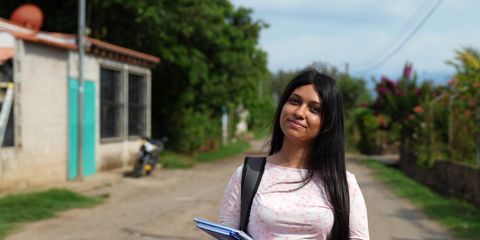
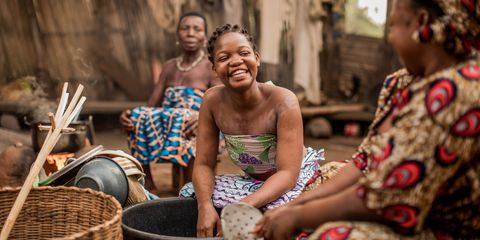
Real Choices, Real Lives was a Plan International research study following the lives of over 100 girls in 9 countries around the world from their birth in 2006 until they turned 18 in 2024.
As a longitudinal and qualitative study, Real Choices, Real Lives has given us rare access to girls’ daily realities, opportunities, and challenges; their experiences of gender and social norms over the course of their childhood and adolescence; their opinions; and their aspirations for the future in their own words.
Real Choices, Real Lives was grounded in a distinct commitment to understanding the root causes of gender inequality by asking questions about beliefs, values, and expectations which aim to uncover how gendered social norms and behaviours are created and sustained or shift over time.
Evidence from the study has been used to support Plan International’s policy, advocacy and programming work around the world: by hearing from girls directly, we ensure that their experiences, ideas, and recommendations for change inform and shape our work.
Find out more or go straight to the reports
About Real Choices, Real Lives (click to expand)
Real Choices, Real Lives followed the lives of over 100 girls and their families in Benin, Brazil, Cambodia, Dominican Republic, El Salvador, Philippines, Togo, Uganda and Vietnam. The study began with 146 girls at the time of their birth in 2006 and concluded data collection in 2024 when the girls turned 18.
Through annual in-depth interviews with the girls and their caregivers, the study explored the girls’ daily realities, attitudes and aspirations for the future. The study has investigated different aspects of the girls’ lives, including their time use, education, sexual and reproductive health and rights (SRHR), and how they navigate gender rules.
A qualitative, longitudinal study of this kind is rare. By following the same cohort of girls over the course of their childhood and adolescence we were able to explore how their experiences changed over time. Real Choices, Real Lives had a distinct commitment to understanding the root causes of gender inequality, and to exploring how girls’ attitudes and behaviours are influenced by their families and communities at different stages of their development.
We have also been able to explore the girls’ experiences in a much greater depth than larger quantitative studies can – by speaking to girls directly, we are able to give voice to the insights and reflections of girls from different contexts around the world.
“It’s good to be heard. To know people care about girls.”
Bianca, 17, Brazil, 2023
About the cohort girls
In Africa, the cohort girls came from Benin, Togo and Uganda; in Asia from Cambodia, Philippines and Vietnam; and in Latin America from Brazil, Dominican Republic and El Salvador. Across all countries, the girls were sampled based on the year of their birth (2006) and on their household context: all of the girls came from the lowest income households in each of their country contexts.
Over the years, a number of the girls left the study for various reasons – including migration and death – and others we unfortunately lost contact with.
By the final year of the study – 2024 – the girls were 18 years old and transitioning from childhood to adulthood, and from secondary education to economic independence, further education and their next steps. A number had married – or were in unions – and some had become mothers themselves. The girls had a range of aspirations and dreams for the future: many wished to be leaders in their communities – including as doctors or teachers, and to have families of their own. They had powerful recommendations and demands for change on issues impacting their lives including gender inequalities, climate action, and access to SRHR information.
“In the future I would like to be a teacher so that I can teach reading and writing to children in my community.”
Tene, 15, Togo, 2021
Our findings
Despite growing up in very different contexts, the cohort girls shared many common experiences during childhood and early adolescence (10-14) including changing social expectations of their behaviour as they get older that are often dramatically different to expectations of their male peers.
“My parents prefer the boys to concentrate on field work and the girls on household tasks. I don’t find this fair.”
Essohana, 11, Togo, 2017
As girls enter adolescence, their attitudes and opportunities are shaped by key family relationships. Caregivers’ concerns about girls’ safety, reputation, and future prospects strongly impact how girls are raised and the freedoms they have. Caregiver-adolescent dialogue is an essential factor in girls’ experiences of sexual and reproductive health and wellbeing, and is heavily influenced by social norms.
“I’d like more information on sexuality, it would help me when I start to go out with boys. I would know how to avoid pregnancy and sexually transmitted diseases.”
Thea, 15, Benin, 2021
Girls and their families in nearly all the cohort countries have experienced some level of food insecurity between 2020 and 2022 with the impacts of the COVID-19 pandemic, extreme weather and global increases in food and fuel costs all contributing to hunger. Climate change has also had an impact on the girls’ education – as well as causing damage to school buildings, loss of livelihoods causes families to be unable to afford the cost of fees and school supplies, forcing girls to drop out of school or miss extended periods.
“The changing weather affects my studies. It’s always raining… we missed a lot of lessons.”
Darna, 17, Philippines, 2023
Girls’ attitudes towards social norms and gendered expectations often shift as they get older. Some girls become more acceptant of restrictions placed on them, while others start to question, challenge or resist them. All the cohort girls have challenged gender norms in at least one area of their lives. Girls’ resistance to inequality is not always visible, however, many girls find ways to negotiate restrictive gender norms.
“[My friends] make fun of me, they say I’m a tomboy, that I’m always playing ball all the time with boys… then I tell them that this is sexist because a girl can play ball just like a boy.”
Juliana, 13, Brazil, 2019
Using evidence for impact
Real Choices, Real Lives evidence has been used to inform Plan International’s policy, advocacy and programming work over the years. Some examples include:
- Real Choices, Real Lives case studies contributed to a joint study with UNICEF and UN Women, highlighting how the lives of adolescent girls have changed over the last 30 years – and the urgent actions needed to ensure girls can reach their full potential and drive development.
- Real Choices, Real Lives findings on girls’ time use and the gendered care divide was used to support Plan International Brazil’s advocacy at the G20 Social Summit (2024).
- Our evidence about the impact of climate change on girls’ education was used to inform Plan International’s engagement at COP28 (2023)
- Findings from the Real Choices, Real Lives cohort girls highlighted that a key barrier in adolescent girls having access to information about sexual and reproductive health and rights was a lack of healthy intergenerational dialogue. In Benin, Plan International used this evidence and partnered with local youth to co-produce radio shows about SRHR issues to encourage supportive dialogues between adolescents and their caregivers (2022).
“I now have a better understanding of hygiene during menstruation.”
Participant in the radio show project in Benin, aged 14, 2023
Learn more about how Plan International uses evidence for impact.
Methodology
Real Choices, Real Lives has been grounded in feminist research principles and developed a strong participatory approach – meaning that girls’ recommendations for change and justice are centred and amplified in not only the work of the study, but the work of Plan International more broadly.
The study conducted data collection annually between 2007 and 2024. As a qualitative study, key methods included in-depth semi-structured interviews with girls and their caregivers. The format of these interviews evolved over time to ensure that they were age appropriate: these have included games and drawing. We also conducted annual household surveys which have allowed us to understand changes in household composition and circumstances over time.
The flexibility inherent in the qualitative approach means that the study was able to explore new lines of enquiry in each round of data collection, reflecting and building on issues present in girls’ lives as they grew up and encountered new experiences, challenges, and influences of gendered social norms.
Plan International received external ethical approval for the Real Choices, Real Lives research study from a certified Institutional Review Board (IRB), and from national ethics boards in relevant focal countries. All research activities for the study were undertaken in line with Plan International’s ethics, safeguarding and data privacy policies and procedures. Principles of confidentiality, anonymity, beneficence, justice and informed consent were always applied, with parents/guardians asked for consent on an annual basis and girls asked to give their assent. All of the cohort girls’ identities are anonymised – the girls were all assigned a pseudonym, and information about their location is removed from the dataset.
“I am happy with this study because I have an opportunity to speak what I have never said before.”
Kannitha, 17, Cambodia, 2023
For more information about the Real Choices, Real Lives study methodology, please see this brief:
Collaboration
Real Choices, Real Lives is a unique dataset of girls’ experiences, attitudes, and daily realities – as told in their own words over 18 years. With rich insight into the lives of girls around the world, this evidence has enormous value across multiple areas – including in policy, advocacy, programmes, and academic research.
From 2021, Plan International collaborated with Cardiff University, using evidence from Real Choices, Real Lives to support a journal article on girls’ everyday acts of resistance, a book chapter on how girls are challenging dominant development discourses, and a pilot study using radio shows to promote healthy intergenerational dialogues between adolescents and their caregivers on sexual health and wellbeing.
In 2025, Plan International and Cardiff University produced research from the study entitled ‘Girls’ Everyday Resistance’, exploring how girls go ‘with’ and ‘against the grain’ of gender norms over the course of their childhood and adolescence.
Marking the end of the study

Thanking the girls in the study
We ended the study by expressing our sincere gratitude to the girls and their families for their invaluable contributions over the past 18 years.
We shared how their information has been used and the impact it has had, and we gave each girl commemorative gifts, including a personalised Letter of Thanks, a Summary of Findings from the Real Choices, Real Lives study, and a personalised Memory Book capturing her life story, experiences, and milestones.
“This [Real Choices, Real Lives] interview always broadens my thinking. Sometimes, even the things I could not imagine thinking, it draws me to it.”
Amelia, age 17 (2024), Uganda
Final Report
To mark the end of the Real Choices, Real Lives study, Plan International released “Real Choices, Real Lives Final Report: Findings from 18 Years of a Global Study with Girls from Birth to Adulthood”. The report brings together 18 years of insights from girls and their caregivers, revealing the progress this generation has made in areas like education, while showing how fragile and uneven these gains remain.
Read the reports
Click to be taken to each report's page