A day in the life of a humanitarian in Gaza
9 April 2026It has been six months since the Gaza ceasefire was announced. Living conditions remain tough but humanitarians, like Khulood, show remarkable resilience.

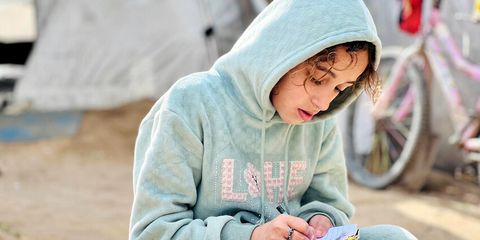
When Khulood first arrived to document Farah’s story, one child stood out immediately. A girl carrying herself with the seriousness of someone much older. Khulood, a pharmacist turned humanitarian worker, listened as Farah spoke about her dreams, her struggles, and her hope to return to school.
Khulood works with Juzoor for Health and Social Development – a key partner of Plan International in the humanitarian response in the occupied Palestinian territory (oPt).
She lives in Gaza with her elderly parents after her home was destroyed by bombing, and she is the person bringing stories like Farah’s to light. On 10 April, it will be six months since the ceasefire agreement in Gaza.
This is what life looks like through her eyes.
The day she met Farah
When Khulood first arrived at the centre, one child immediately stood out. “She immediately caught my attention, walking around wrapped in a blanket instead of a jacket, carrying herself like an adult.”
With Farah and her family’s consent, they began talking. Farah spoke about her desire to return to school, her need for pens and notebooks, and how she still remembers every detail of her brother’s injury – while holding on to hope for his recovery.
“Even amidst hardship, children can carry hope and resilience that inspire everyone around them.”
Khulood, Humanitarian Worker
“I was impressed by her joy and pride in the services available to her, and I realised that even amidst hardship, children can carry hope and resilience that inspire everyone around them.”
Stories like Farah’s stay with Khulood long after the conversation ends.
“Hearing stories like Farah’s affects me deeply – I feel a personal responsibility to help, to understand what we can offer each person. While these stories carry an emotional weight, they also bring me positivity, renewed hope, and increased energy, which I try to pass on to others who have lost their passion and hope for life.”
A day in Khulood’s life
Khulood’s days are not easy. After her home was destroyed, she and her parents moved first to a tent they set up on a rooftop, and later to a small apartment on the seventh floor. For her 82-year-old father, who can no longer leave the house, this means he is effectively confined. For Khulood, it means carrying everything – food, water, medicine – up seven flights of stairs, every day, while also working full-time as the family’s sole provider.
Getting to work is its own challenge. With little to no transportation available, she often needs to walk long distances just to get there. On the way, she passes rubble and destruction, tents, and children begging in the streets. “When I’m eating or drinking something, I often can’t finish it because I can’t bear to see the children while I have food or water,” she says.

There is sewage everywhere, and the smell comes from all directions. And as she walks, memories surface – of how each street used to look, what once stood there. “There was a restaurant here, a coffee shop there, a school in another place,” she recalls. “I remember my presence in these places, and it fills me with sadness.”
Coming home is the best part of her day. “When I return home and reassure myself that my parents are safe and well.”
Yet the challenges of her work never leave her. She describes the helplessness she feels when an elderly person comes looking for medication that isn’t available, or when a malnourished child arrives at the centre and there is nothing to offer.
One day, in particular, captures that weight. She had been unable to find essential medication for her father. After a long shift, she got home and realised she had forgotten to bring water and had to go back down, carry it up, and climb seven floors again.
“It was a day that made me want to cry. But instead, I played music to lift my mood and keep going.”
“Everyone is closely watching events across the Middle East, worrying about what may come next.”
Six months after the ceasefire
On 10 April, it will be six months since the ceasefire agreement in Gaza, and life is slowly, cautiously moving again – some schools have reopened, and for the first time in years, Eid brought some moments of celebration.
“Schools reopened, allowing children like Farah to attend again, which has had a positive impact on their mental well-being,” says Khulood.
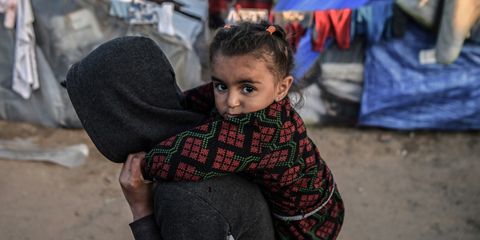
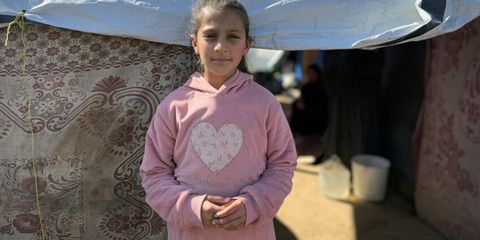
But the ceasefire has not brought an end to violence and fear. Attacks have continued, access to humanitarian aid remains inconsistent, and most families are still living in tents. Water and electricity supply is unreliable, prices keep rising, and the uncertainty about what comes next is constant.
Humanitarian needs have not stopped, and the scale of what needs to be rebuilt – homes, health systems, infrastructure, education – makes the work of organisations like Juzoor and Plan International more urgent than ever.
Added to that comes geopolitical uncertainty. “Even when conflicts occur beyond Gaza, people feel the potential consequences. Everyone is closely watching events across the Middle East, worrying about what may come next – we have already endured so much.”


Khulood plays the oud at the Juzoor health centre to keep spirits up. Image credit: Juzoor / Plan International.
What keeps Khulood going
Despite all challenges, Khulood describes herself as someone who laughs often and looks for reasons to smile. “The last time I truly laughed was just yesterday with my colleagues – we laughed so hard for no reason. We are always trying to create moments of joy and keep smiling.”
And she holds on to her dreams. Khulood wants to pursue a PhD. She hopes to keep supporting her family. And she has one wish for Gaza. “I wish for simple things to exist in Gaza, like a cinema. That is one of my simplest dreams.”
“We are capable, intelligent people who love life and its details, and we want to live like others around the world. We are skilled and deserve better,” she says. “Patience and resilience – they have carried us and given us the strength to keep going, no matter the challenges we face.”
Plan International, together with Juzoor for Health and Social Development, continues to support communities in Gaza through health, protection, and psychosocial services.
People like Khulood and children like Farah are at the centre of that work, every single day.
Related pages