Girls’ rights and gender equality
Challenging the social norms, attitudes, and barriers that hold girls back, driving transformative change for them and their communities.
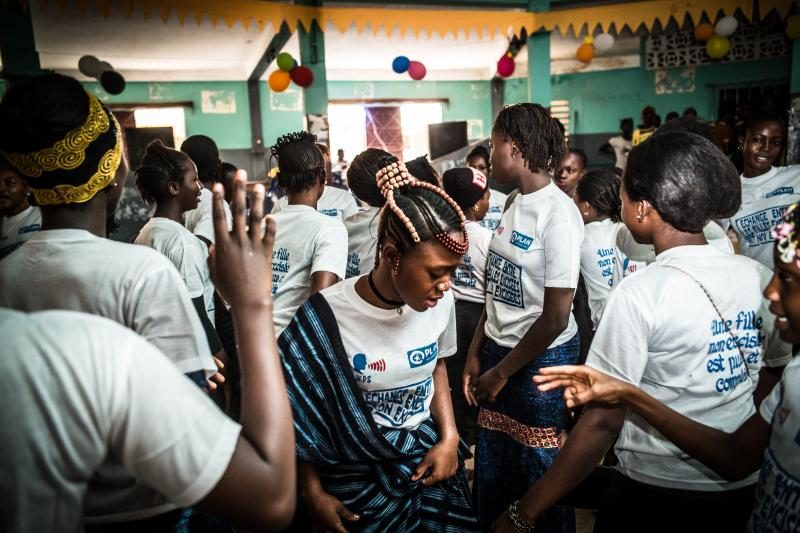
At Plan International EU, we work to challenge the social norms, attitudes, and barriers that hold girls back, driving transformative change for and with girls and their communities. Globally, one in five girls is denied an education because of poverty, violence and discrimination. Every day, girls are taken out of school, married far too young, and subjected to abuse. This is a violation of their rights, and a huge loss of potential with far-reaching consequences.
We know that investing in girls has the potential to transform the lives of entire communities and countries. That’s why we advocate for girl’s rights to be central to EU external action, in development, humanitarian action and beyond. Girls’ rights and gender equality is woven across our work on children’s rights, youth economic empowerment, child protection, humanitarian response and sustainable development.
Our calls to the EU
- The EU must provide adequate resources to fund gender equality in the external instrument of the Multiannual Financial Framework (MFF).
- All international cooperation and humanitarian programmes must take a rights-based approach to gender equality, focusing on the most marginalised and excluded girls and young women.
- Girls and young women must be meaningfully involved in EU decision-making, so their priorities and needs shape the policies that affect their lives.
- The gender transformative approach must sit at the heart of the EU’s gender equality guidelines, including challenging discriminatory social norms that limit girls and their communities.
- The EU should adopt a life-cycle approach that responds to the different needs and challenges girls and young women face at different stages of their life.
- Finally, EU policies and programmes should support girls and young women in all their diversity, underpinned by the principle of intersectionality.
EU Gender Action Plan IV
In 2020, the EU adopted its third Gender Action Plan (GAP III) – Putting women’s and girls’ rights at the heart of the global recovery for a gender-equal world. GAP III set out clear commitments, targets, and guidance to integrate gender equality across the EU’s international partnerships and global action. A successor to GAP III is expected in 2026 and we would like for this the GAP IV to go further.
The year 2027 will be a critical moment for gender equality. It will mark the end of the EU’s Multiannual Financial Framework (MFF) and GAP IV negotiations. This is a key opportunity for the EU to take a strong stand for girls and young women, in all their diversity, and to turn commitments into real change worldwide.