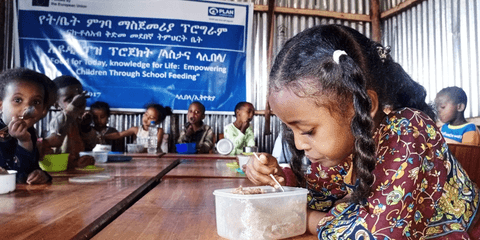
School feeding programme launch for crisis-affected learners
Plan International Ethiopia's school feeding program tackles hunger and boosts education in crisis-affected areas, supporting thousands of children and famil…
We stand with girls to protect their right to learn, lead, and shape their own futures even in the most challenging times.

Across Ethiopia, too many girls are being pushed out of school by conflict, poverty, displacement, and harmful norms. When a girl loses access to education, she loses far more than a classroom. She loses safety, choice, and the chance to determine her own future.
We won’t let that happen.
Girls in Ethiopia are facing more risks and fewer opportunities than ever before. Ongoing conflict and displacement have forced millions out of school, with over 4 million children in Amhara alone unable to access education in 2024. Destroyed classrooms, unsafe learning environments, and a shortage of trained teachers continue to widen the gap.
Only 65% of girls complete primary school, and 90% of children struggle to read age‑appropriate text by age 10. source
When crises escalate, girls are the first pulled out of school and the last to return.
But girls are not giving up, and neither are we.
Temporary and mobile classrooms ensure education continues in conflict and displacement-affected areas, preventing permanent dropout.
Plan International Ethiopia supports every part of a girl’s learning journey, from early childhood to primary school and through crisis. We work where children face the greatest barriers: conflict, displacement, poverty and school closures.
We work hand-in-hand with government, teachers, and local organisations to:
When learning environments are safe, inclusive, and predictable, girls gain the confidence, skills, and resilience they need to thrive.
Rehabilitated classrooms and gender-sensitive WASH facilities protect girls’ dignity, safety, and attendance, especially during menstruation.

In times of crisis, we act fast.
We set up temporary and mobile classrooms, provide emergency education supplies, and support teachers to care for children who have experienced trauma.
We prioritise girls, children with disabilities, orphans, and families with the lowest incomes ensuring that even in crisis, children continue learning, connecting, and dreaming.
Trained teachers use child-centred, inclusive, and psychosocially sensitive methods so girls don’t just attend school, they learn and thrive.
For thousands of refugee children arriving in Ethiopia, education is interrupted sometimes for years.
Our accelerated learning programmes give older children (10+) the chance to catch up to Grade 3 or 5 levels using a condensed curriculum designed for crisis contexts.
We train refugee teachers to:
When refugee girls return to learning, they gain hope and a pathway to a safer future.
Accelerated learning programmes help over-age learners regain lost years of education and re-enter formal schooling with confidence.

Through the PlayMatters project, we make education joyful, inclusive, and healing.
By integrating play-based learning in classrooms and communities, we help children aged 3–12 build resilience, understand their emotions, and develop critical life skills during and after crisis.
Teachers, caregivers, and community leaders are trained to use play to strengthen literacy, numeracy, problem-solving, creativity, and emotional well‑being.
When children learn through play, they learn for life.
Play-based learning strengthens literacy, numeracy, emotional wellbeing, and resilience for children affected by crisis.

We work to transform classrooms into spaces where girls feel seen, valued, and empowered.
This includes:
Quality education isn’t just about access it’s about ensuring children learn with confidence, dignity, and joy.
By working with government and local partners, improvements last beyond projects, benefiting future generations of girls.

“Rainwater used to leak into our classrooms, making it hard to concentrate.
– Hawi Abeyot, Student
The floors weren’t cemented, and dust affected many of us.
With the new classrooms, library, and ICT rooms, learning has become much more comfortable and engaging.”
Our programmes ensure that education is possible everywhere in schools, homes, refugee camps, and community centres. We combine academic learning with life skills, digital literacy, emotional resilience, and environmental awareness to prepare children for the world they deserve.
Girls stay in school longer, learn better, feel safer, and gain the confidence to lead their own futures even in the hardest circumstances.
Our goal is simple: make sure no child is left behind.