We work with girls so every child can grow up feeling safe, cared for, and free from fear at home, at school, and in their community, even during emergencies.
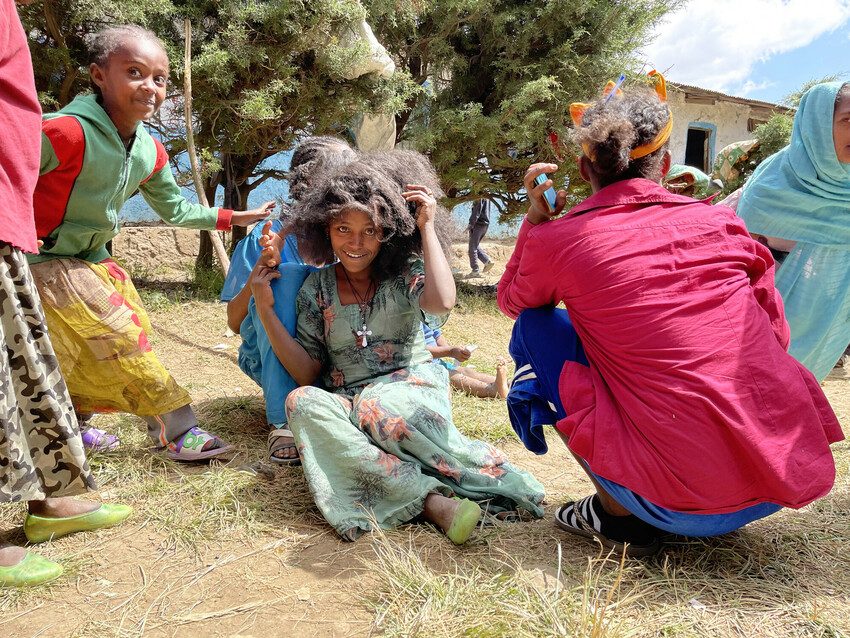
Children playing in a internally displaced persons camp in Ethiopia.
Across Ethiopia, conflict, displacement, harmful gender norms, and economic instability continue to expose children especially girls to violence, exploitation, and discrimination. From child marriage and forced labour to sexual and gender‑based violence (SGBV) and harmful traditional practices like female genital mutilation (FGM), the risks are rising.
But girls are speaking out, communities are taking action, and we are standing with them to make sure progress never stops.
Why protection matters now
Children and young people in Ethiopia face some of the highest protection risks in the region. Conflict has uprooted families, schools have closed, and safety nets have weakened leaving girls more vulnerable than ever.
Ethiopia continues to face:
Rising SGBV: 27% of women and girls experience physical, sexual, or psychological violence.Source
Child labour: Affecting 51% of boys and 39% of girls.Source
Child marriage: Increased during school closures and crises.Source
Teenage pregnancy: Driven by early marriage and limited SRHR services.Source
FGM: Still widely practised due to social pressure and entrenched norms.
Displaced children and families including refugees and internally displaced peoples (IDPs) face the highest risks of violence, exploitation, and abuse. When girls lose access to school, safe spaces, and support systems, their futures narrow.
This is why protection work has never been more urgent.
Our approach: Standing with girls, supporting every part of their world
Our work focuses on keeping children safe, supporting families, and helping communities protect their own children.
We do this by:
Preventing and responding to violence: We work to stop harmful practices like child marriage, female genital mutilation (FGM), and violence against girls and women. We also make sure children and survivors can access safe, respectful support services.
Strengthening protection systems: We support local and national systems to identify, refer, and support children at risk, including those separated from their families. This includes helping reunite children with their families whenever possible.
Changing harmful social norms: We work with communities to challenge beliefs and practices that harm children and promote equality, especially for girls.
Empowering children and young people: We equip children and youth with knowledge, life skills, and confidence so they can protect themselves, make informed choices, and speak up.
Supporting parents and caregivers: We help parents learn positive parenting practices, so children grow up in safer, more supportive homes.
Providing mental health and emotional support: We offer psychosocial support to children affected by trauma, helping them recover, rebuild confidence, and feel safe again.
Creating safe environments: We establish safe spaces in communities and schools where children, especially girls, can learn, play, and access support without fear.
What makes our work different
We focus on girls and young people: Everything we do is designed to meet the specific needs of adolescent girls and young women, who are often the most at risk but least supported.
We work where the need is greatest: We operate in some of the most challenging and underserved areas, including refugee settings like Gambella and regions affected by ongoing crises.
We connect emergency response with long-term change: We don’t just respond to immediate needs we also help communities build stronger systems that last beyond the crisis.
We bring communities, government, and partners together: We work closely with local communities, government systems, and humanitarian partners to strengthen protection systems and ensure coordinated support.
We innovate to reach young people: We pilot new approaches like sports-based programmes and youth-led initiatives to engage young people in preventing violence and promoting positive change.
We take a holistic approach: We connect protection with other areas like education and livelihoods, so children and families receive the full support they need.
What this looks like in real life
Over the past three years, our work has helped hundreds of thousands of children and families stay safe, recover, and rebuild their lives.
Children protected and reunited with families
Over 5,000 child protection cases managed in Gambella alone
2,787 children reunited with their families after separation
Thousands more children supported across Tigray, Amhara, Afar, Oromia, and Benishangul-Gumuz.
Tens of thousands of women, girls, and community members reached with gender-based violence prevention and response services
Safe referral systems established so survivors can access care and support.
Stronger families, safer children
Parenting programmes helped families create safer home environments
Life skills training supported adolescents to avoid risks like early marriage, exploitation, and unsafe migration.
A Safer future for Ethiopia’s children
By supporting families, helping girls lead, and strengthening community-based protection, we are working toward an Ethiopia where every girl and child grows up safe and free from violence.
We make sure girls have the power, knowledge, and support to make informed choices about their bodies, health, and futures in every community and every crisis.
In Afar, Ethiopia, baby girls are often subjected to painful and life-threatening FGM as early as one week after birth. But families are working together to …
We use functional cookies to make this site work. We’d also like to set optional cookies to measure site usage, personalise content and tailor advertising to your interests. To choose which cookies to enable, click on Settings. For information about the cookies we use, see our Privacy Policy and Cookie Notice.