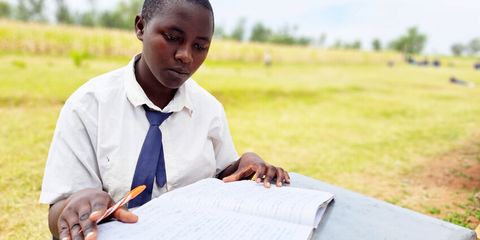
Married at 13, Mbalu* grew up without information about her body or her rights. Through sexual and reproductive health outreach, she is now gaining knowledge she was never taught and using it to protect her children’s future.

As a child, Mbalu used to watch planes crossing the sky and whisper, “I want to fly too.” But before she reached her first menstrual cycle, her family married her off in exchange for 25 cows. The dreams she carried quietly were replaced by responsibilities she was not prepared for.
“I wanted to fly planes, but I was never given the chance to go to school.”
~ Mbalu
“I wanted to fly planes, but I was never given the chance to go to school,” she says. “None of my 7 siblings went to school. The boys went to graze animals, and we girls stayed home, waiting to get married.”
In Mbalu’s family, girlhood ended early. Education was never discussed as a possibility, even though the girls wanted it.
“We used to see other girls walking to class and they always looked so happy,” Mbalu recalls. “But there was nothing we could do. I don’t remember anyone asking me what I wanted.”
A common reality for many girls
Mbalu’s experience reflects a wider national reality. 22% of girls aged 15–19 in Tanzania have already begun childbearing, and the teenage birth rate is 112 births per 1,000 girls. Girls with lower levels of education face the highest risk of early pregnancy.
In places like the village where Mbalu lives, these numbers are not abstract. They shape the lives and futures of girls every day.
At 13, Mbalu went through the traditional steps leading to marriage, locally known as chagulaga, a Sukuma custom meaning “choose among us.” It usually takes place during harvest festivals, community gatherings, or sometimes spontaneously in the village.
Her husband was 17 and also out of school. They began their lives together in an extended family compound with other young women who shared similar stories of early marriage and early motherhood.
By the age of 17, Mbalu was already a mother of 2. Her first child is 3 years old, and her second is 1 year and 9 months old. During a recent clinic visit, she learned she is pregnant again.
“I don’t know what to say, time passed very quickly and slowly at the same time,” she whispers.
Learning through whispers, not facts
Like many girls married young, Mbalu learned about her body through whispers rather than facts. She relied on mhege, a traditional belief that tying small sticks around the waist could prevent pregnancy.
“They said one stick meant 1 year without pregnancy. I trusted what they told me.”
~ Mbalu
“They said one stick meant 1 year without pregnancy. I wore 5, hoping it would keep me safe. Yet here I am, pregnant again. There was nothing else I knew,” Mbalu explains.
When information finally reached her door
In 2023, the Adolescent Girls’ Health and Rights project, known locally as “VUMA” began community outreach visits in her area. Funded by Global Affairs Canada and individual Canadian donors, the project is implemented by Plan International and its partners, Femina Hip and UMATI in Tanzania’s Katavi region. Its ultimate outcome is to increase the realisation of sexual and reproductive health and rights (SRHR) for adolescent girls and young women in all their diversity.
During one of these outreach visits, a community health worker supported by the VUMA project learned about the young wives living together in the compound and decided to reach out.
“The reception was harsh, they told me I was bringing trouble and asked me to leave,” the health worker recalls. She continued visiting patiently. Over time, trust began to build.

More than a year later, Mbalu and the other young women walked to the clinic together for the first time. They shared their experiences and asked questions openly.
“I was so happy to see them that day,” the health worker says. “I explained everything about their bodies. I worried it was too much information at once, but they listened closely.”
Eventually, the women agreed to begin modern family planning. Before Mbalu could start, routine screening revealed she was already pregnant again.
“I cried a lot,” Mbalu says. “I had finally understood my body and my choices, but I arrived too late.”
Still, as part of family planning support under the VUMA project, Mbalu continued attending clinic sessions. There, she learned about pregnancy spacing, reproductive health services and how to make informed decisions in the future. Over time, her confidence grew. After many discussions, her in-laws agreed she could begin learning how to read and write through a community-based adult literacy initiative.
A different future for her children
Today, Mbalu practises reading at home and shares what she has learned about health and her body with other young women in her community.
“I cannot be a pilot now, but my children… they can still fly. They can dream to be doctors, teachers whoever they want. They have a protective mother now,” Mbalu says.
*Name changed to protect identity.
Related pages